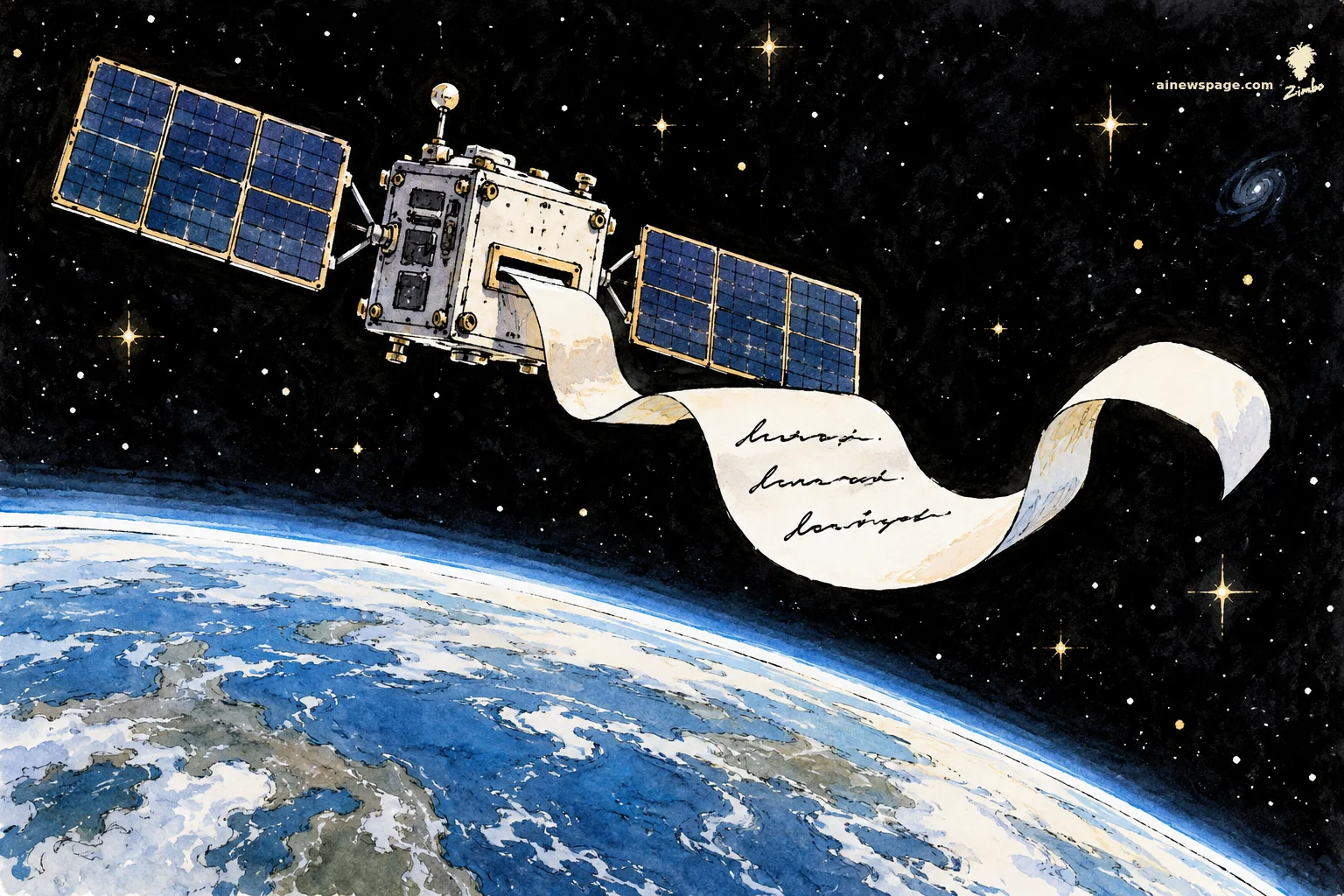

The story behind the cartoon
Google's Project Suncatcher prototype satellite reached its 'Hello World' milestone this week, the company said: the first-ever AI response from a data-center-class TPU in orbit. The prototype launched on October 1 aboard a SpaceX Transporter-18 rideshare mission, built in partnership with Planet, as the first step in Google's long-term research moonshot to explore powering AI compute in space.
During a ground-station pass, engineers uplinked their first prompt to the satellite's onboard Gemma 4 open model, asking it to write a haiku about being in space. As the spacecraft passed over Svalbard, Norway, it downlinked the poem, confirming the chain from prompt to orbital compute to response worked. Google then tested space-themed limericks and telemetry prompts reporting the technical status of the payload systems.
The prototype carries four Google TPUs and generates up to 1 kilowatt of electricity, TechCrunch reported, enough to operate one TPU at a time for about 20 minutes before thermal limits intervene. The ongoing test campaign will examine how the chips perform under thermal stress and in the space radiation environment, with twin interconnected satellites planned for 2027 if the hardware proves reliable.
The joke is the stationery: a machine built to do the heaviest computing humanity can devise, parked above the entire planet, answers its first question by unspooling a long handwritten poem like a Victorian pen pal. It did not send back a status code. It sent back verses, in cursive, from orbit.
 THE ROBOT GETS LAID OFF
 THE INTERNATIONAL HELP DESK
 THE MACHINE EATS ITS OWN PAYCHECK
 THE HELPFUL ASSISTANT.