The story behind the cartoon
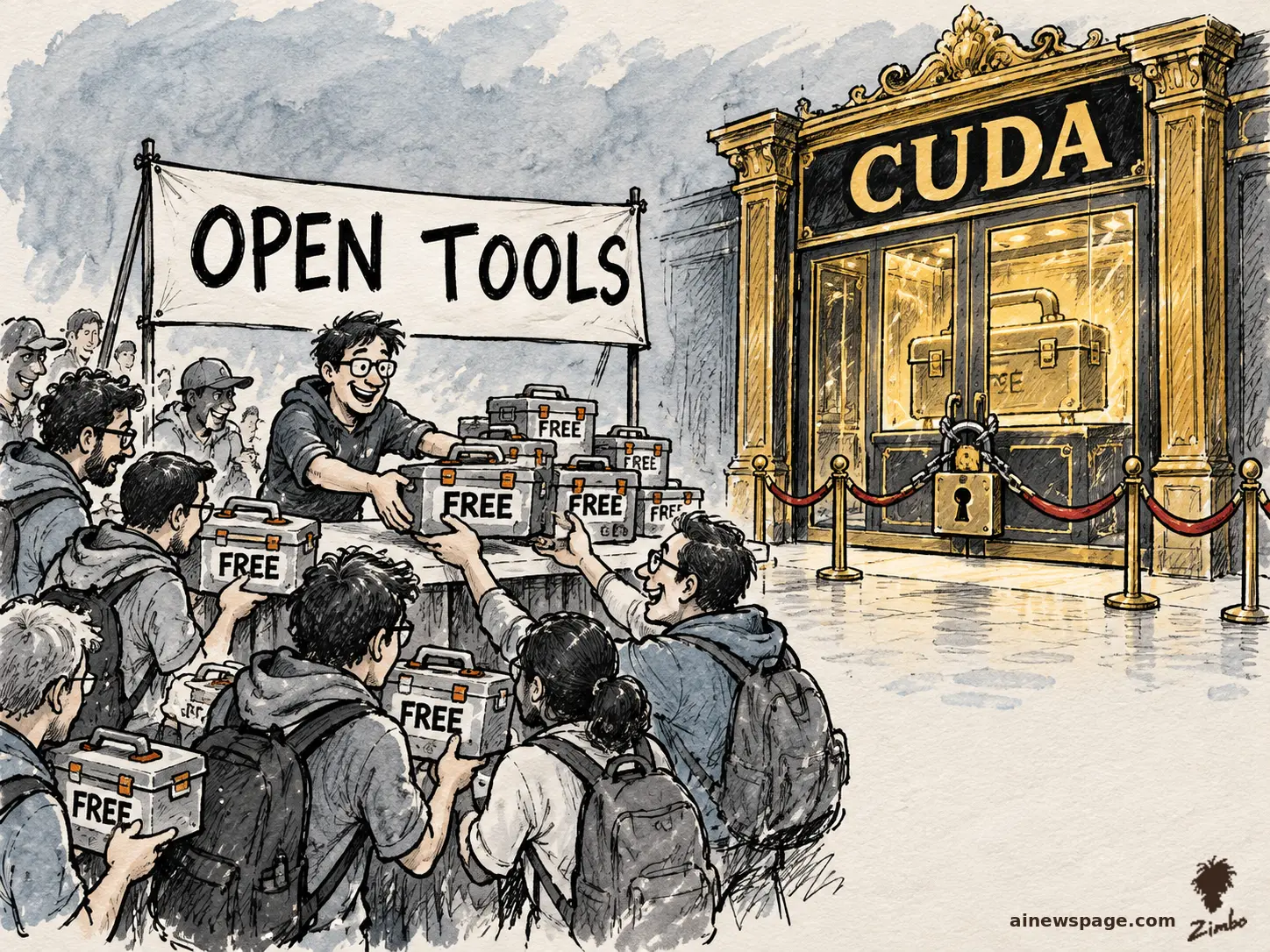
On September 30, 2026, Bloomberg reported — via Startup Fortune's account — that DeepSeek had open-sourced a full programming toolkit for Huawei's Ascend AI chips, free for anyone to download. The centerpiece is TileLang, a higher-level programming language DeepSeek says can replace Nvidia's CUDA, the software platform that has underpinned AI development for more than a decade. Around it sit DeepGEMM for matrix operations, DeepEP for large-scale communication between chips, TileKernels for standard vector computation, FlashMLA for long-context attention, and DeepSelect for data filtering — together mirroring the toolkit DeepSeek already built for Nvidia GPUs, rebuilt from scratch for Huawei silicon, in a direct bid to give China's AI industry a working alternative to Nvidia's software.
The target is the lock-in, not the chip. CUDA has kept customers on Nvidia hardware for years because switching means months of rewriting code, debugging, and clawing back lost performance; DeepSeek is trying to erase that cost for any Chinese company willing to jump to Ascend. The technical case has been building: research from DeepSeek, reported by Tom's Hardware, puts Huawei's Ascend 910C at about 60% of the inference performance of Nvidia's H100, with manual optimization of the chip's CUNN kernels pushing the figure higher, and DeepSeek's PyTorch library now converts CUDA code into CUNN, Huawei's equivalent — the friction-removal that makes migration realistic. DeepSeek and Huawei have also been working on a supernode design linking 128 Ascend 950 chips, and DeepSeek says the TileLang approach already supports most of the operators used in training its V4 model series.
The giveaway is the second half of a longer move. DeepSeek released V4 in April 2026 — a 1.6 trillion parameter model that reportedly matched GPT-5 and Claude Opus on benchmarks — and, according to reporting from DeepLearning.AI's The Batch, gave early performance-testing access to Chinese chipmakers rather than to Nvidia or AMD; Capacity reported that ByteDance, Tencent, and Alibaba then rushed to lock in orders for Ascend 950 processors. The backdrop is Washington: Nvidia's H20, the cut-down chip built to comply with US export rules for China, has faced its own licensing troubles, and the export controls are the entire reason Huawei's Ascend line exists as a serious alternative. Startup Fortune's verdict is the blunt one: sanctions were supposed to keep Chinese labs dependent on Nvidia, but you can restrict a chip — it is much harder to restrict a piece of open source code that anyone can download and improve. What happens next depends on adoption beyond Huawei and DeepSeek themselves.
The joke: a crowded OPEN TOOLS table hands FREE toolboxes to a line of engineers while the gold-padlocked CUDA store next door sits empty. The moat was never the chip. It was the toll booth — and DeepSeek just opened a free road around it.
 THE LITTLE ROCKET THAT COULD
 THE UNINVITED FIXER
 JUST ONE MORE QUESTION.
 THE FEDERAL CLEANOUT.