01
THE 20% IS THREE PEOPLE, NOT THREE HUNDRED
The Doom Index's median comes from exactly three eligible point estimates: Hinton's hedged 10%, Bengio's rough 20%, Christiano's 20%. That is below the index's own 5-person display floor — the thin-panel caveat is printed right under the number, because a median of three is a snapshot of who's on the record, not a scientific consensus. Honest pooling means printing the caveat as loudly as the number.
02
SAME NUMBER, DIFFERENT DOOM
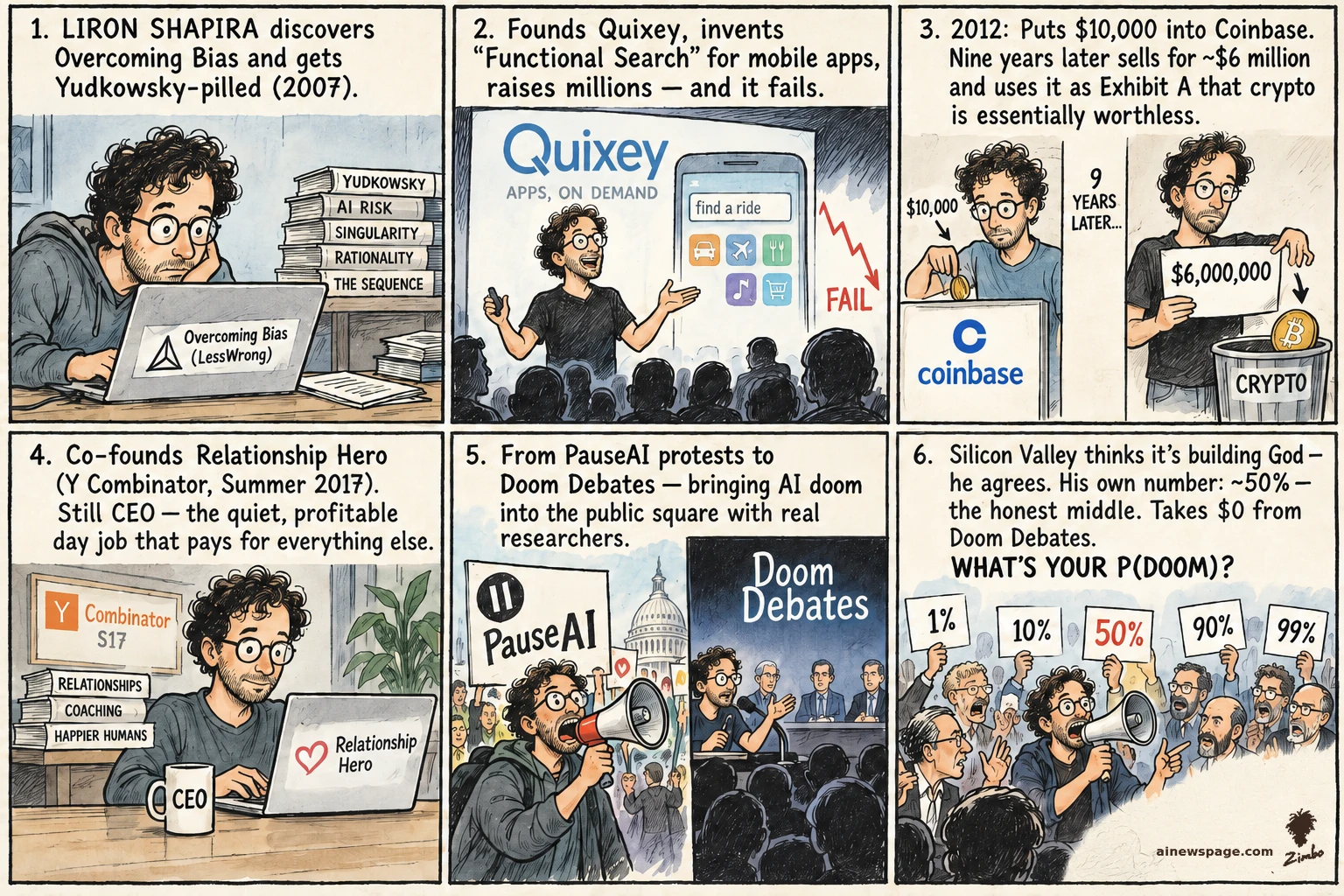
Bengio's 20% is 'around, like, 20 per cent probability that it turns out catastrophic,' with no fixed horizon. Christiano's 20% is 'most humans die within 10 years of building powerful AI.' Hinton's 10% prices humanity being wiped out on roughly a ten-year timeline — hedged with 'nobody really knows how to give a sensible estimate.' Shapira's ~50% is 'the honest middle: not 1 percent and not 99 percent, since either one bets the species at absurd odds.' Every tracked estimate is a version of doom. None of them is the same doom.
03
THE RANGES DON'T GET TO VOTE
Amodei's 10–25% (civilizational collapse — later walked back with '25% is too high') and Musk's 10–20% ('end humanity,' with 'the probable positive scenario outweighs the negative scenario') are stated ranges. Hubinger's is a lower bound: more than 10% within the decade. The index lists all of them and pools none of them — midpointing a range invents a precision nobody stated. A range is honesty about uncertainty. Treating it as its middle is lying about it.
04
SOME VOICES REFUSE THE NUMBER
Altman and Hassabis signed the 2023 statement that mitigating AI extinction risk should be a global priority alongside pandemics and nuclear war — and neither has a personal numeric estimate on the audited record. Declining to price it is itself a position: some risks are worth treating as serious without pretending they can be decimalized. The most powerful labs in the world will sign the statement and still won't give you a number.