01
8,000 VIRUS MACHINES, PUBLIC, BEFORE THE OUTBREAK
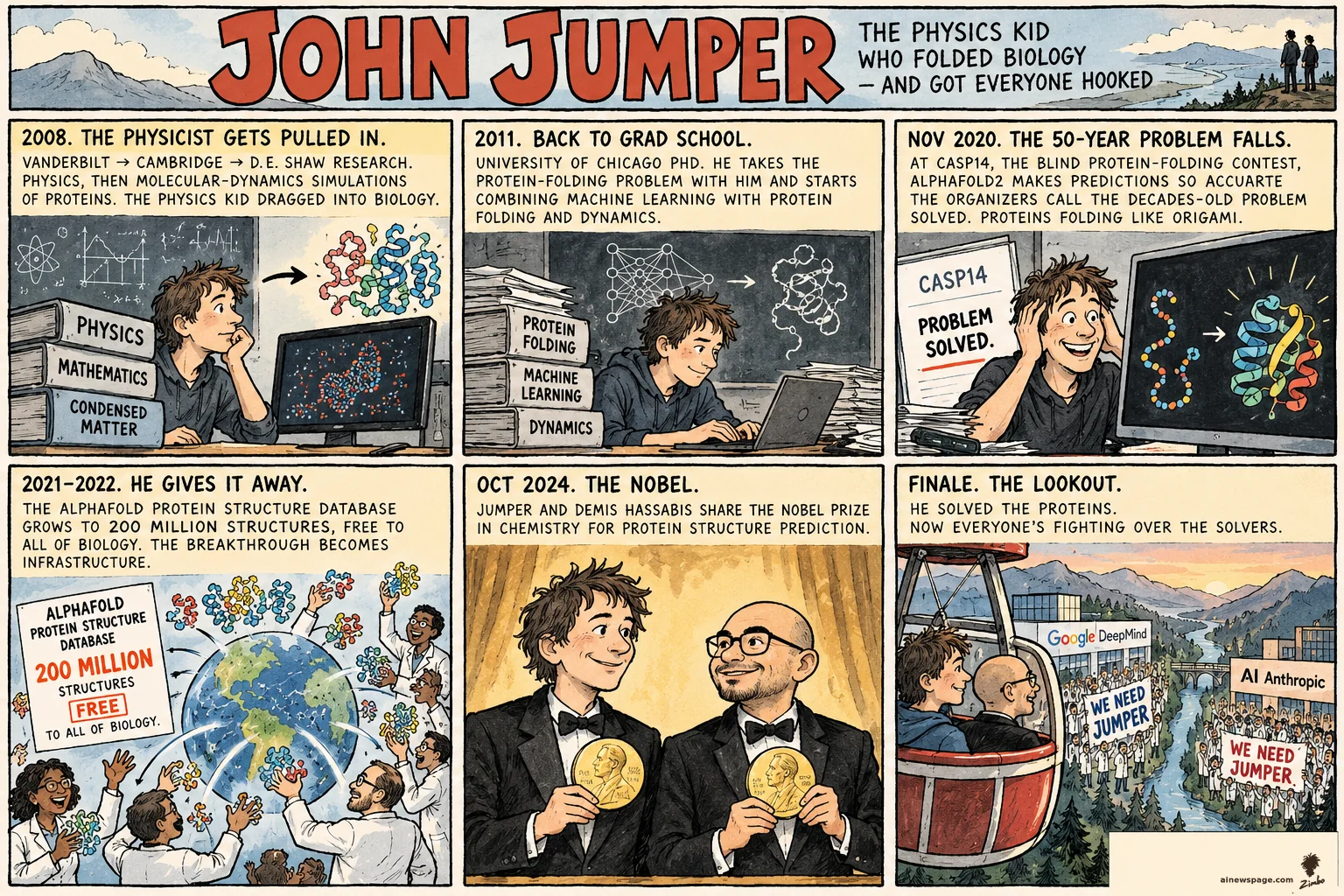
On September 24, 2026, researchers added more than 8,000 predicted virus protein dimers — pairs of interacting molecules — to the AlphaFold Protein Structure Database, launching a 'pandemic preparedness portal' for viruses with human-infecting members. Earlier in 2026 the database had already gained 1.7 million predicted pairs from 20 widely studied organisms. 'Many viral proteins do not act individually, they act in concert with partners,' said molecular virologist Joe Grove of the University of Glasgow, part of the effort. Roughly 30% of the added interactions represent structural insights never documented in the Protein Data Bank. Thousands of dangerous viruses, structurally previewed, free, before the outbreak. Five years ago that was science fiction.
02
AN 'OFF SWITCH' NOBODY KNEW EXISTED
Cornell researchers used AlphaFold to uncover a previously unknown way cells control how proteins move inside them — a process essential for growth and communication that is often disrupted in cancer. The AI generated a shortlist of likely protein interactions for experimental testing, replacing months of traditional lab screening. The study, published September 9 in the Journal of Cell Biology, shows a little-understood protein called Avl9 acts as an 'off switch' for another protein, Arf1, part of a broader previously unrecognized system. 'Instead of traditional lab screening, which can take months, the AI software quickly generated a shortlist,' the researchers reported. AI didn't just speed up the search. It found a door nobody knew was there.
03
THE BLUEPRINT IN THE APHIDS
A 2026 PNAS study used AI structure prediction to crack open one of biology's weirdest arms races: aphid proteins that hijack plant cells. The team generated roughly 2,400 high-confidence structure predictions across seven aphid species and kept finding the same saposin-like fold, duplicated and redecorated — proteins evolving on two fronts at once, reaching new targets inside the plant while staying unrecognizable to the plant's immune surveillance. AI is now the field instrument for watching evolution cheat in real time.
04
THE DRUG QUESTION HAS ITS OWN DEEP DIVE
Reading biology faster is step one. Turning it into medicine is a separate war — targets, trials, manufacturing, approval. The full field guide on whether AI actually discovers drugs faster lives here, with the McKinsey numbers and the clinical-trial track record. This guide is the map of life. That one is the war over the pharmacy.