

The story behind the cartoon
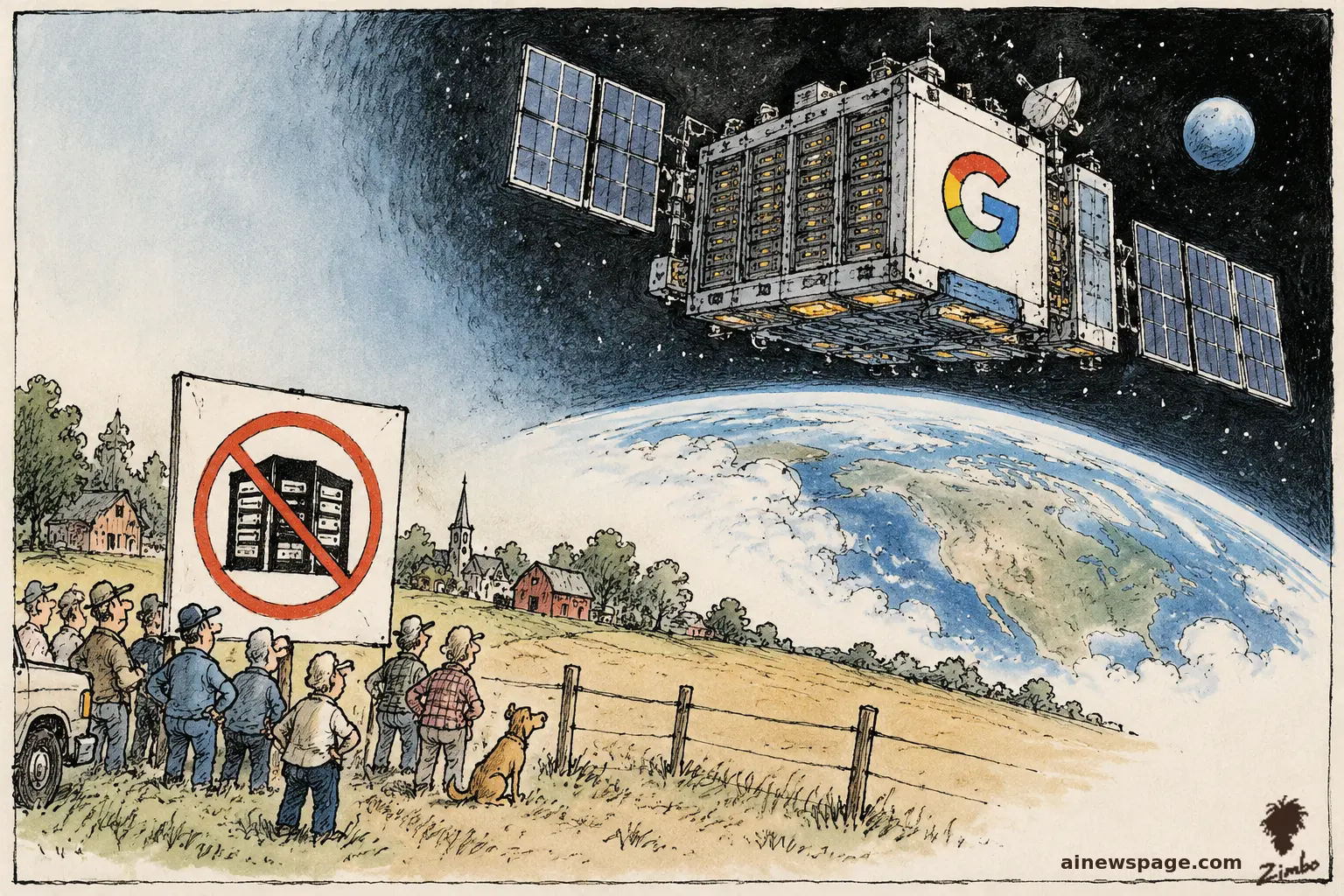
As rural communities across the United States wage intensifying battles to keep AI data centers out of their backyards, Google is testing an answer that sidesteps the neighbors entirely: orbit. The company launched the first test satellite for Project Suncatcher, its orbital data center initiative, aboard a SpaceX Falcon 9 rideshare mission, Transporter-18, out of Vandenberg Space Force Base in California. The satellite's job is narrow and physical — to find out how Google's tensor processing units, its TPUs, perform after the jarring forces of a rocket launch and in the radiation-riddled environment of space. 'This first launch is about seeing what works, identifying points of failure, and applying those findings to future missions,' said Travis Beals, Google's senior director of paradigms of intelligence. Two more test satellites are planned for 2027.
The physics is the hard part. Radiation in orbit causes bit flips — data errors — and steadily shortens hardware life; ground simulations at the Crocker Nuclear Laboratory at UC Davis showed the TPUs fared 'remarkably well,' but, as Google concedes, some things can only be tested in space. Heat is worse: on Earth, data centers shed it by evaporating water, but in a vacuum there is no air to carry heat away, so orbital facilities will likely need massive radiators and heat pipes. The prototype mostly dodges the problem — a Google spokesperson told CNN the test vehicle will 'have to power down every 20 minutes, because we don't want it to overheat,' running on only about 1 kilowatt of power. Working AI data center satellites may need 50 to 100 kilowatts, the range in Google's own paper in the journal Joule; today's telecommunications satellites run on 10 to 20. The 2027 pair is supposed to operate continuously and may test beaming data between satellites by laser, a trick so far demonstrated at scale only by SpaceX's Starlink.
Whether any of it pays is another question. AI chips advance every one to two years while satellites last five to seven, making hardware obsolescence a persistent challenge, as a June report from JLL Research put it; the same analysis concludes orbital data centers only beat terrestrial ones if launch prices drop dramatically — and launch costs are climbing, not falling. SpaceX holds the structural advantage, building its own rockets and leading in satellite production, and has said it plans a constellation of up to 1 million AI-computing satellites; Google's 2025 paper proposed clusters of 81. Google's partner, Planet Labs, is patient: its cofounder and CEO Will Marshall called it 'a very viable project long-term' that will take significant R&D dollars. Google's own line is that it is playing the long game. There are, CNN notes, no guarantees the technology will work or that it will ever make economic sense.
The joke: rural townspeople gather around a NO-DATA-CENTER protest sign on a farm while a Google-branded orbital server satellite with solar panels floats above the Earth. The towns said no to the data center in their backyard. Google's answer is everybody's sky.
 THE LANDLORD’S LITTLE CONDITION
 THE ONE-DAY HOSTAGE CRISIS
 THE PREMIUM CONFESSIONAL
 THEY SUED TO KEEP THE HOOK